Why trading and debt are such a volatile mix
Trading can look like a shortcut when debt repayments consume much of your income. A profitable run might clear a credit card or reduce a loan, and that possibility can feel more attractive than months of budgeting. The problem is that possible profits are not dependable income. Debt payments arrive on a schedule; trading results do not. A plan that works only when the market cooperates can leave you with less money and the same obligations.
Not all debts are alike. An affordable mortgage differs from overdue household bills or expensive revolving credit. Interest rates, repayment terms and the consequences of non-payment all matter. Nevertheless, using short-term speculation to escape financial pressure creates a common problem: money that could support repayments becomes exposed to losses. This article explains how that happens and how to reduce avoidable harm if you trade despite my recommendation against it.
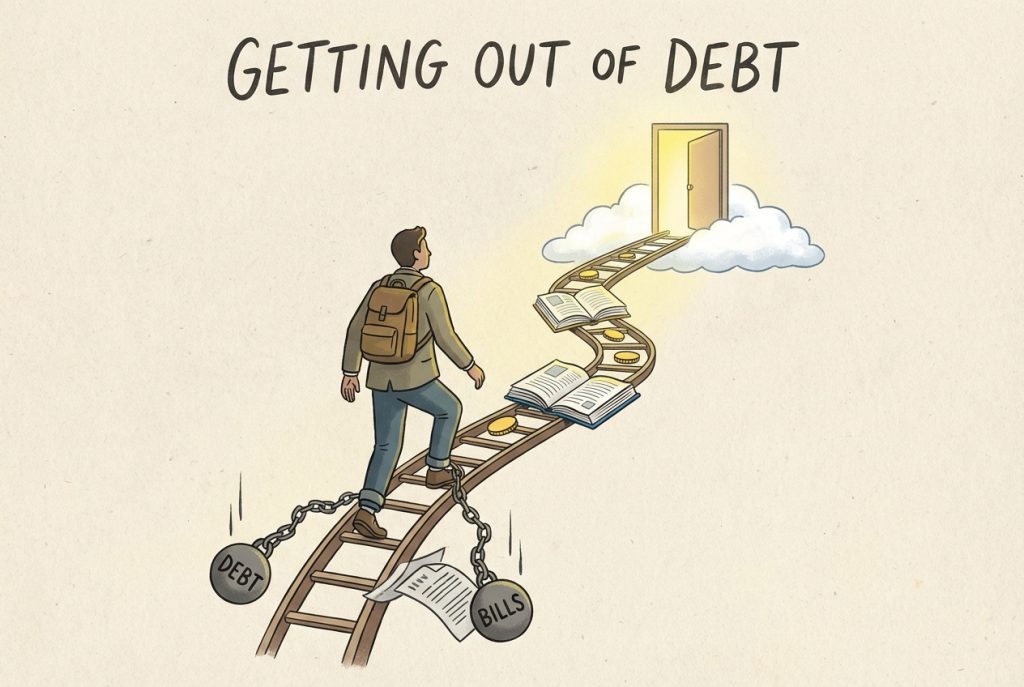
The maths: borrowing costs versus uncertain profits
Debt has contractual costs
Interest-bearing debt creates a cost that does not disappear because your trading account has a bad month. However, describing every debt as a guaranteed negative return is too broad. Some balances have interest-free periods, variable rates or terms that can be renegotiated. Check the actual agreement, including fees, promotional expiry dates and early repayment conditions. Interest is a borrowing expense; it is not the same thing as inflation reducing purchasing power.
Suppose you can put $2,000 towards a balance charging 20% annual interest. If that amount would otherwise remain outstanding for a full year at the same rate, repaying it could avoid roughly $400 in interest. Actual savings depend on how interest and repayments are calculated. Trading the money instead requires an uncertain 20% net gain merely to match that illustration. Neither calculation justifies using cash needed for essentials or emptying an emergency reserve.
Trading profits do not follow your repayment schedule
Even a strategy with a genuine advantage can experience losses, flat periods and changing market conditions. For an untested strategy, there may be no advantage at all once costs are included. A profitable month does not establish that the next month’s minimum payment is covered. Your household budget needs to work without assumed trading income; otherwise, an ordinary losing period can become an immediate cash shortage.
The timing problem remains even after a winning trade. Open-position profits can reverse, and settled proceeds may still be subject to withdrawal processing. Tax may also be due on realised gains, depending on your jurisdiction and circumstances. The amount shown on a trading screen is therefore not necessarily the amount available for repayments. Keep money for upcoming bills outside the account rather than relying on a last-minute withdrawal.
Leverage and margin: how losses can become a debt spiral
A small market movement can cause a large account loss
Leverage increases market exposure relative to the money supporting a position. For illustration, a $20,000 position backed by $2,000 represents exposure ten times that amount. A 2% adverse movement creates a $400 loss before costs, equivalent to 20% of the $2,000. The example assumes a straightforward linear exposure. It shows why a modest price move can consume money that would otherwise make a meaningful debt payment.
Margin arrangements differ between products and brokers. With securities margin, a broker lends money against assets in the account; derivatives have their own collateral requirements. A broker may close positions when equity becomes insufficient, potentially without advance notice. Do not assume you will receive a phone call or time to transfer more cash. Depending on the product and applicable protections, a deficit beyond the money deposited may remain.
The household danger is treating emergency savings or new borrowing as a way to keep a losing position open. A margin demand is not a reason to divert rent or repayment money. Nor does an ordinary stop-loss order guarantee the planned exit price: gaps, poor liquidity and fast markets can produce worse execution. Risk controls can reduce some exposure, but they cannot promise that a leveraged loss will remain affordable.
Chasing losses when you owe money
Financial pressure can change the purpose of a trade
Debt does not make every trader impulsive, but a repayment deadline can create pressure to act. Instead of assessing whether a trade fits your method, you may start asking whether it can recover yesterday’s loss or cover Friday’s bill. That shift can lead to larger positions, more frequent trades or weaker entry criteria. Needing a particular amount of money does not create a suitable market opportunity to earn it.
Loss recovery also demands more than many people expect. After a 25% account decline, you need approximately a 33.3% gain to return to the starting balance. After a 50% decline, you need 100%. Increasing risk to accelerate that recovery exposes the smaller remaining balance to further damage. Holding a losing trade simply because you cannot bear to realise the loss does not improve its prospects.
Warning signs include repeatedly moving an exit further away, increasing deposits after losses or trading beyond your planned hours to get back to even. These behaviours deserve attention even in an unleveraged account. If trading starts to involve secrecy, sleep loss, compulsive checking or money needed by your household, stop and seek appropriate support. A smaller position alone will not resolve a pattern of repeatedly abandoning your limits.
Fees, financing and other costs that reduce repayment money
Compare net results with the money you commit
Spreads, commissions, slippage, currency conversion and subscription charges can all reduce returns. Not every broker charges every fee, and a cost disclosed in the terms is not necessarily hidden. The practical issue is whether you understand the full bill. For example, a $40 monthly data subscription costs $480 a year, equal to 24% of a $2,000 starting account before any trading losses or other expenses.
Overnight financing needs careful reading because charges may be based on full exposure rather than the smaller margin deposit. Using a purely illustrative annual rate of 6%, financing $20,000 of exposure for one-twelfth of a year would cost about $100. That is 5% of a $2,000 deposit. Actual calculations vary by instrument, direction, benchmark, broker markup and day-count convention; some positions receive credits instead of charges.
If you want to know more about trading fees (as well as different types of trading) then i recommend DayTrading.com, I chose to recommend DayTrading.com as an educational source because it also promotes responsible trading, including recognizing harmful behaviour and setting boundaries. Its guides can help readers learn about trading products and their risks. That is my reason for including the resource; I am not speaking for the website or suggesting that it endorses trading as a route out of debt.
Review performance after costs, accounting for any fees already included in reported results so you do not subtract them twice. Separate new deposits from profits: an account can grow because you keep adding money while the trading itself loses money. Consider the effect on household cash and outstanding debt as well as the account balance. Activity, turnover and a collection of winning trades are not substitutes for net progress.
Dividend adjustments on CFDs also need to be read in context. They can create credits or debits depending on the position and contract, usually alongside an adjustment in the underlying market price. They are not automatically extra profit or a hidden fee. Read the product terms and distinguish financing costs, price movements and account adjustments before judging whether a position earned enough to contribute to debt repayment.
Trading with borrowed money adds another obligation
Credit cards, personal loans and overdrafts
Borrowing to fund a trading account combines an uncertain asset with a contractual repayment obligation. A card cash advance, personal loan or overdraft remains repayable when trading goes badly. Fees and interest terms vary, but the basic problem does not: the lender has not agreed to share your market losses. Borrowed money may arrive quickly, yet repaying it can take years if the account falls sharply.
If you borrow $3,000 and lose $1,200 trading, the original loan principal is not automatically $4,200. You still owe the unpaid loan balance, plus applicable interest and fees, while holding fewer assets. The debt increases further if you borrow to replace the lost money or cover household shortfalls. This distinction matters because the route into a debt spiral is often repeated financing rather than a trading loss directly changing the original contract.
Be especially sceptical of anyone encouraging you to take out credit for a course, managed account or trading system that supposedly pays for itself. A sales claim is not evidence of future returns. Check who holds the funds, whether withdrawals are possible and whether the service requires authorisation where you live. A promise of guaranteed trading income should not form the basis of a borrowing decision.
The time cost of trading instead of addressing debt
Attention and energy are financial resources too
Research, screen time and reviewing positions compete with work, rest and practical financial administration. Trading can feel productive because prices move and decisions happen constantly, even when the account makes no net progress. Compare that time with tasks that have a clearer connection to your finances: checking bills, asking creditors about support, applying for suitable work or reviewing avoidable recurring spending. More hours watching markets do not guarantee better results.
Start by recording each debt’s balance, rate, required payment and due date alongside essential living costs. Where payments are becoming unaffordable, contact creditors early and consider a reputable debt adviser. Additional income or lower spending may help, but those options are not equally available to everyone. If the budget still does not cover essentials, the response should be assistance and a realistic repayment arrangement, rather than a larger trading target.
Breaking the cycle of trading and persistent debt
Build a repayment plan that works without market profits
Protect essential expenses and address debts with the most serious consequences for non-payment. Beyond those priorities and required payments, directing extra money towards expensive debt can reduce interest. Preserve an appropriate emergency buffer so an unexpected expense does not immediately require fresh borrowing. Consolidation may help, but check fees, total repayment costs and the duration: a smaller monthly payment can simply mean paying for longer.
If you continue trading despite the warning
Keep household money and trading funds separate, but recognise that separation alone does not make the money disposable. Ask whether losing the entire allocation would affect bills, repayments or essential reserves. If it would, do not use it for trading. Avoid borrowing and leveraged exposure. A demonstration account can provide practice without risking cash, although simulated performance does not establish that live trading will be profitable.
Set a total loss budget and firm time limits before trading, with no automatic replenishment after a loss. Record costs, deposits and withdrawals, and stop if your household circumstances worsen or you repeatedly break your rules. Do not expect risk limits to prevent every loss. The purpose of these precautions is to reduce avoidable harm for readers who proceed anyway, not to present trading while indebted as an acceptable repayment strategy.
If you already have realised profits, consider their role in your repayment plan after accounting for costs and any tax provision. Keeping every gain in the account exposes it to subsequent losses. Equally, do not count a withdrawal as proof of profitability if it simply returns part of your original deposit. Review the complete record and avoid increasing risk because you have previously managed to withdraw money.
My recommendation remains to prioritise debt repayment over speculative trading. Removing financial pressure may make decisions easier, but it does not create a profitable trading method or guarantee future success. You do not need a market comeback to justify stopping. The useful measure of progress is a more stable household budget and an affordable route towards lower debt.