Why trading and debt are such a volatile mix
Debt by itself is simple. You owe a fixed amount, pay interest, make monthly payments. The rules are clear, however annoying. Trading is not simple. Returns vary, losses can cluster, and outcomes arrive on their own schedule. When you put the two together, things can get messy faster than people expect.
On paper, trading looks like a way out. If you hit a good run, you might cover a card balance, make a dent in a loan, or at least stop that feeling that you are always one bill behind. In practice, the combination of fixed obligations and variable trading results often keeps people in debt longer, even if they are not obviously “bad” traders.
The main reason is structural. Debt is a guaranteed negative return. Every month you carry it, you pay for the privilege. Trading, unless you are already operating at a very high level, is at best a slightly positive expectation with plenty of volatility and long dull patches. You are combining something that is steadily pulling you down with something that jumps up and down unpredictably.
On top of that, being in debt changes how you trade. You are less patient, more outcome-focused, and more attracted to anything that promises big gains quickly. That usually means more leverage, more short-term bets and less discipline. Over time the behaviour created by the debt itself can keep the debt alive, even if your original trading ideas were not terrible.
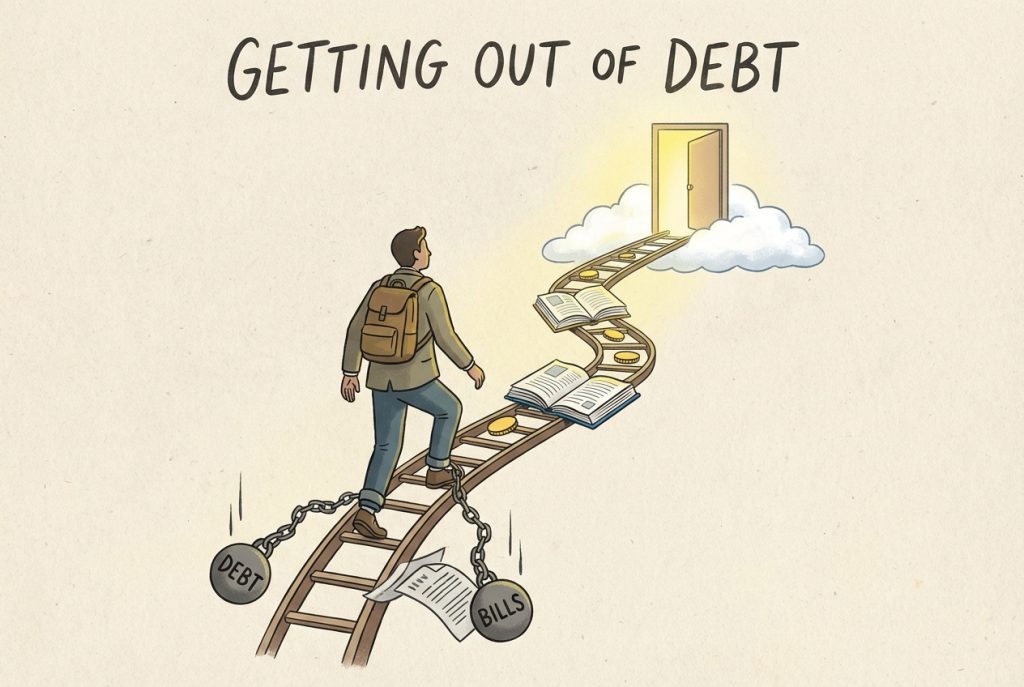
The math problem: negative certainty versus uncertain upside
Debt has a guaranteed cost
Most consumer debt has a clear, non-negotiable return, and that return is bad for you. Credit cards, overdrafts, buy-now-pay-later deals that roll into interest, unsecured loans, often sit at interest rates that would be called predatory if you saw them printed on a trading product.
If a card charges, say, twenty percent per year, every dollar you carry on that balance is losing that percentage in purchasing power unless you reduce it. Paying that card down is, in simple math terms, the same as earning a risk-free twenty percent on capital, before tax. There is nothing on a trading platform with that kind of certain return.
Even lower-rate debts, like some personal loans or car finance, still have predictable drag. You know exactly how much interest you will pay over the term if you only make minimums. That creates a baseline for your financial life. Below it, you drown. Above it, you slowly surface.
Trading returns are noisy and unreliable
Trading returns are nothing like that. A good month, a bad quarter, a flat year, all can happen without warning. And that is assuming you have a robust method. Many retail traders do not, specially in the early years. Their actual expectation is negative after spreads, swaps, slippage and mistakes.
The problem is not just that results are noisy. It is the mismatch in timing. Your credit card bill does not care that this month happened to be a drawdown in your strategy. The minimum payment is still due. If you plan on trading profits to fund those payments, you are relying on a process with no guarantee to cover an obligation that absolutely does have one.
That mismatch keeps people in debt in a quiet way. On a run of good trades, they might make a lump payment, feel better, then see nothing much happen for three months while interest keeps accruing. On a run of losses, they may stop payments to protect the account, which makes the total owed grow even faster.
If you think of debt as a constant drain and trading as a variable hose that sometimes flows and sometimes does not, the issue becomes obvious. Unless the hose is both very strong and very reliable, the drain wins over time.
Leverage and margin: turning ordinary drawdowns into debt spirals
When a normal losing streak becomes a crisis
Even a good trading system has losing streaks. You can be right only forty or fifty percent of the time and still make money if your winners are larger than your losers, but that also means you will see runs of several losses in a row just by chance. That is normal.
Leverage and margin turn those normal streaks into potential account events. If you risk too much per trade, or run too many positions at once, a bad week can chop a large chunk off equity. That hurts any trader. It hits someone in debt in a different way.
When you are already committed to repayments, a twenty or thirty percent drawdown is not just a painful chart. It can mean skipping or shrinking a debt payment, or cutting necessary spending to recapitalise the account. You have much less room to say “this was a rough patch, I will cut size and ride it out” because obligations outside the account have not gone away.
Margin calls can push this along. If you hold leveraged positions and they move against you, the broker will demand more collateral. If you can not provide it, positions are closed at bad levels. That crystallises losses right when your personal finances are least able to absorb them. Traders without debt can sometimes respond by stepping back, saving for a few months and rebuilding slowly. Traders with debt tend to respond by finding more money somewhere, which usually means more borrowing.
What would have been a standard drawdown becomes the start of a spiral. Losses drive more borrowing. Borrowing raises the need for quick profits. That pressure pushes you back toward high risk trades. The next drawdown lands harder.
“Chasing back losses” when you owe money
How pressure changes your decision making
Almost everyone who trades long enough feels the urge to “get back to even” after a bad run. When you are in debt, that urge is stronger, because the losses are not just a dent in a trading log, they are blocking you from paying down something that already makes you anxious.
That pressure changes the kind of trades you choose. Instead of patiently waiting for setups that actually fit your plan, you are more likely to take marginal ones, or to increase size on the next signal to try to cover past losses more quickly. In your head, you are not taking extra risk, you are just “accelerating” the plan.
The market does not care about your acceleration. It still throws up streaks, bad fills, slippage, news shocks. With higher size, each one hurts more. Before long, you are in a game of digging out of a deeper hole using the same shovel that created it.
Debt also makes closing a loss harder. If you already feel behind, admitting a trade is wrong and taking the hit feels like moving backward. So you hold, negotiate with yourself, move stops wider, add to the position “to improve the average”. You are delaying the emotional pain in the moment, which makes the financial pain worse later.
All of this is present even if you are trading unleveraged spot positions. With leverage it becomes more acute. Every choice is scaled up. The more trading decisions you make from a place of “I have to fix this” rather than “this is the right position for this setup”, the more likely trading is to hold you in the debt zone rather than help you leave it.
Fees, swaps and hidden costs that quietly extend debt
Why small frictions matter more when you are in the red
Trading costs come in several forms: spreads, commissions, financing charges for holding positions overnight, data fees, platform fees, sometimes inactivity fees. On a big account with no debt, these are normal business expenses. On a small account run by someone with existing obligations, they chew up capital that was already scarce.
Consider overnight financing. If you hold CFD or margin FX positions for days, you pay or receive swaps. Most retail accounts pay more often than they receive. Over a month, that can be a few percent of the position’s notional value. On index or share CFDs there can also be adjustments around dividends and corporate events that move cash in your account without you realising how much of the flow comes from your side. You can learn more about how these high-risk trading types work by visiting DayTrading.com.
Frequent trading multiplies these frictions. If you are taking several trades per day chasing a “rescue” move, every entry and exit pays the spread or commission. If you close and reopen positions instead of sizing correctly at the start, you refresh all those costs. Over hundreds of trades, they form a slow leak.
That leak keeps you in debt because the gross results you see on a chart are not the net results that hit your balance. You might be proud of a month where your winners added up to a decent amount, but after spreads, swaps and a few bad exits, your account barely moved. Meanwhile, the interest on your debts was very real.
Debt squeezes your buffer. That makes frictions matter more. What might have been an acceptable cost structure for a well-capitalised trader becomes a drag that cancels out the thin edge someone in a tighter position manages to generate.
Trading with borrowed money: stacking one risk on another
Credit cards, personal loans and broker credit
The most direct way trading keeps people in debt is when they start trading with debt itself. That can mean taking a cash advance on a card to fund a trading account, using a personal loan to “capitalise” a strategy, or quietly dipping into an overdraft to meet margin calls. Some brokers also offer internal credit lines, letting you run positions that are large relative to equity.
This looks rational from inside the situation. You tell yourself that you are simply borrowing at a certain rate to invest at a higher return. In theory that is exactly what leverage in business or real estate often does. The difference is that in those cases the expected cash flows and risks are, at least in part, linked to something with a clear economic basis, like rent or operating profits.
In trading, especially short-term trading, your edge is often thin and unproven. You are borrowing at a guaranteed positive rate against a strategy that might be flat or negative after costs. The gap between those percentages is what keeps you in debt.
Another issue is that borrowed money feels different psychologically. People are more willing to risk funds that arrived in a lump from a lender than they are to risk savings built slowly. That often leads to position sizes that do not match the trader’s real skills, because in their head they are risking “the bank’s money” rather than months of their own labour.
Once the borrowed capital is hurt, you are left with the worst possible outcome: repayments on a loan, or an extended card balance, and no trading account of any meaningful size. To rebuild, you either have to save even more, which is hard when you have monthly obligations, or borrow again, repeating the cycle.
Using trading profits to accelerate debt repayment is one thing if the trading is small, consistent and funded from genuine surplus cash. Using debt to accelerate trading is another. The first can help reduce debt over time if the edge is real. The second usually keeps debt alive or makes it larger.
Time cost: trading instead of fixing the balance sheet
Opportunity cost of attention and energy
Trading does not just consume money. It consumes time, focus and emotional energy. When you are in debt, those are also resources you need for other tasks, like working extra hours, improving income, negotiating better terms with creditors, or simply thinking clearly about spending.
A trader with no obligations who spends evenings testing systems or watching charts is making a trade-off between hobbies. A trader in debt doing the same might be allocating their best concentration to an activity that, at least for now, is not reliably solving the underlying issue.
The more screen time you put in, the easier it is to justify not taking other steps. It feels like you are “doing something” about money, even if the net effect on your debt over six months is zero or negative. That illusion of progress, created by constant price action and the occasional exciting win, can delay more boring but effective actions like cutting recurring costs or asking for more hours at work.
Burnout is another quiet factor. Trading under pressure is tiring. People who spend late nights trying to “make it back” often end up under-performing at their main job or side gigs. That can slow salary growth, reduce bonuses or tip performance reviews the wrong way. The knock-on effect keeps income lower than it might have been, which in turn keeps debt around longer.
You can see trading as a project competing for your limited resources. If it is not yet consistently generating more than it consumes, and if you are in a hole financially, it is easy for that project to delay the more direct work of climbing out.
When trading habits lock in a “permanent debt zone”
What has to change for debt to actually shrink
Trading keeps people in debt not just through individual bad runs, but through habits. Over time, patterns form. Depositing into an account as soon as a card limit frees up. Running size too large relative to equity. Treating trading as the main potential escape, so every other improvement in finances goes to “giving the strategy one more try”.
That can create a kind of steady state. Debt never becomes catastrophic, but it also never really declines. Trading is active enough to give the feeling that you are working on it, but not effective enough, after costs and mistakes, to move the numbers. You sit for years in a band where balances wobble up and down without breaking lower.
Breaking that pattern usually requires at least one shift. Sometimes it is moving trading from “escape plan” to “small side activity”, funded only from money left after fixed repayments, with tight size and low or no leverage. Sometimes it is pausing trading altogether for a while to build an emergency buffer and pay down the highest-rate obligations, then returning with less pressure.
On the trading side, it often means accepting that slow compound growth is the only sustainable aim. That is hard when part of your brain still wants a big hit to wipe out the debt in one chart pattern. It means risking less per trade, taking fewer trades and accepting that debt reduction will mainly come from boring things like consistent repayments, not from a breakout on a thirty-minute chart.
The irony is that trading often becomes more profitable once the debt pressure is gone. Decisions are cleaner, risk can be set at sensible levels, and you are not tempted into impulsive bets just to move a monthly statement. If you are stuck in the mix of trading and debt, that is worth remembering. The goal is not to quit trading forever, it is to stop using it in a way that quietly traps you on the wrong side of the balance sheet.